Comelec-Bacolod tells bets to follow common poster areas

BACOLOD CITY — The Commission on Elections (Comelec) here is reminding candidates to follow the rules on designated common poster areas as the campaign period for national positions start this week.

A day after the campaign for senators and party-list groups began on Tuesday, City Election Officer Mavil Majarucon-Sia led her staff in checking the compliance and they were able to take down illegally posted campaign materials in some areas around the city.

Marajucon-Sia said on Wednesday, they were able to go around in about 10 villages, and took down several posters and tarpaulins.
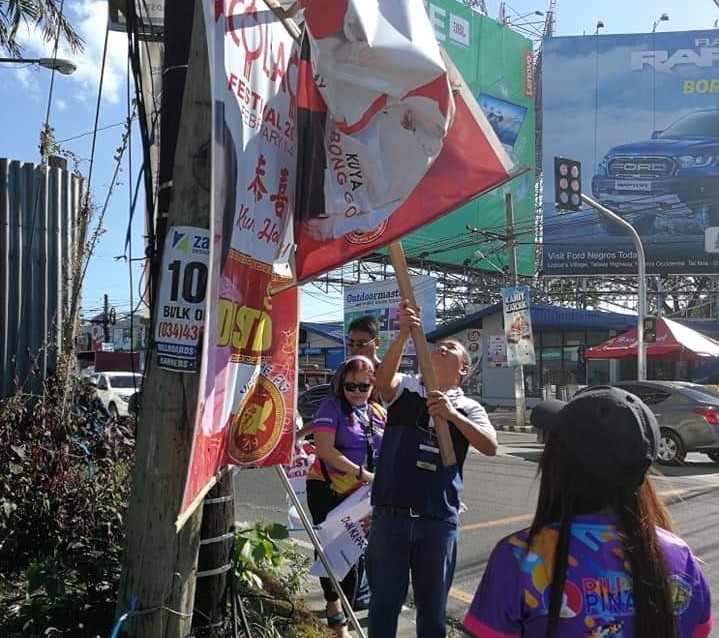

Personnel of Commission on Elections in Bacolod City take down illegally posted campaign materials on Wednesday (Feb.13, 2019).
Photo courtesy of Comelec-Bacolod

“For now, we can only take down the posters of those running for senators and partylist representatives. Although we have observed the violations are not blatant,” she said.

Marajucon-Sia noted that local coordinators of some senatorial candidates have taken down their large campaign tarpaulins before February 12.

During the “Operation Baklas” on Wednesday, they were able to take down only less than 10 campaign materials since the rest were already removed.

In Bacolod, the Comelec has identified at least 92 common poster areas in the 61 barangays for the May 13 elections.

Among these are located in covered courts, gymnasiums, areas near the barangay halls, and vacant lots along the highways.

Campaign materials with size not exceeding two feet by three feet can also be posted in a private property with consent of the lot owner.

Marajucon-Sia said as the campaign period continues, the Comelec-Bacolod personnel will try to conduct inspections at least twice a week to monitor the candidates’ compliance with the rules on common poster areas.

Candidates whose campaign posters are installed on trees may be charged for violating Section 3 of Republic Act 3571, which prohibits the cutting, destroying or injuring of planted or growing trees, flowering plants and shrubs or plants of scenic value along public roads, in plazas, parks other than national parks, school premises or in any other public ground.

Violators may be charged with an election offense, which is punishable with one to six years in jail, disqualification from holding public office and deprivation of the right to vote. (PNA)

Source: http://www.pna.gov.ph/articles/1061937

Unvaccinated students in West Visayas to get measles shots

BACOLOD CITY — The Department of Education (DepEd) 6 (Western Visayas) has announced the conduct of a school-based measles immunization for unvaccinated Grades 1 and 7 students across the region from February until the end of March.

Victor de Gracia Jr., officer-in-charge of the Office of the Assistant Regional Director, said in a memorandum dated February 12 addressed to all school division superintendent that there is an urgent need to reach unimmunized learners in all schools due to the recent measles outbreak in the region.

The DepEd Division of Negros Occidental posted a copy of Regional Memorandum No. 050, series of 2019, on its Facebook page on Wednesday night.

De Gracia said the measles vaccination and Vitamin A supplementation program will be conducted in partnership with the Department of Health (DOH) 6 during the period.

“Immediate parental consent shall be secured for identified unimmunized learners,” he added.

De Gracia also directed all doctors, nurses and staff of the Health and Nutrition Units to take the lead in the prompt implementation of the program in their respective divisions.

For the current school year, DOH-6’s free school-based health services aim to reach 123,771 Grade 1 pupils and 155,314 Grade 7 students in Western Visayas for immunization against measles, rubella, tetanus, and diphtheria.

From January to February 12, DOH-6 has recorded 359 suspected measles cases in Western Visayas, 144 of which were from Negros Occidental.

Measles is a contagious viral illness characterized by fever, rash, cough, runny nose, and red eyes. This could be transmitted through the air, droplets, or direct contact with nasal and throat secretions of infected persons. (PNA)

Source: http://www.pna.gov.ph/articles/1061896

Bacolod renews ties with South Korean city

BACOLOD CITY — Bacolod has strengthened its sister city ties with Seogu District, Daegu Metropolitan City of South Korea to pave the way for exchanges in the fields of tourism, culture, and trade.

Mayor Evelio Leonardia together with Councilors Em Ang and Cindy Rojas visited Daegu last week upon the invitation of the Federation of Art and Culture Organization.

“Seogu is one of the eight districts of Daegu, the fourth largest city in South Korea. We were trying to renew our sister city agreement with Seogu District,” Ang said in a press briefing held at the City Mayor’s Office on Wednesday afternoon.


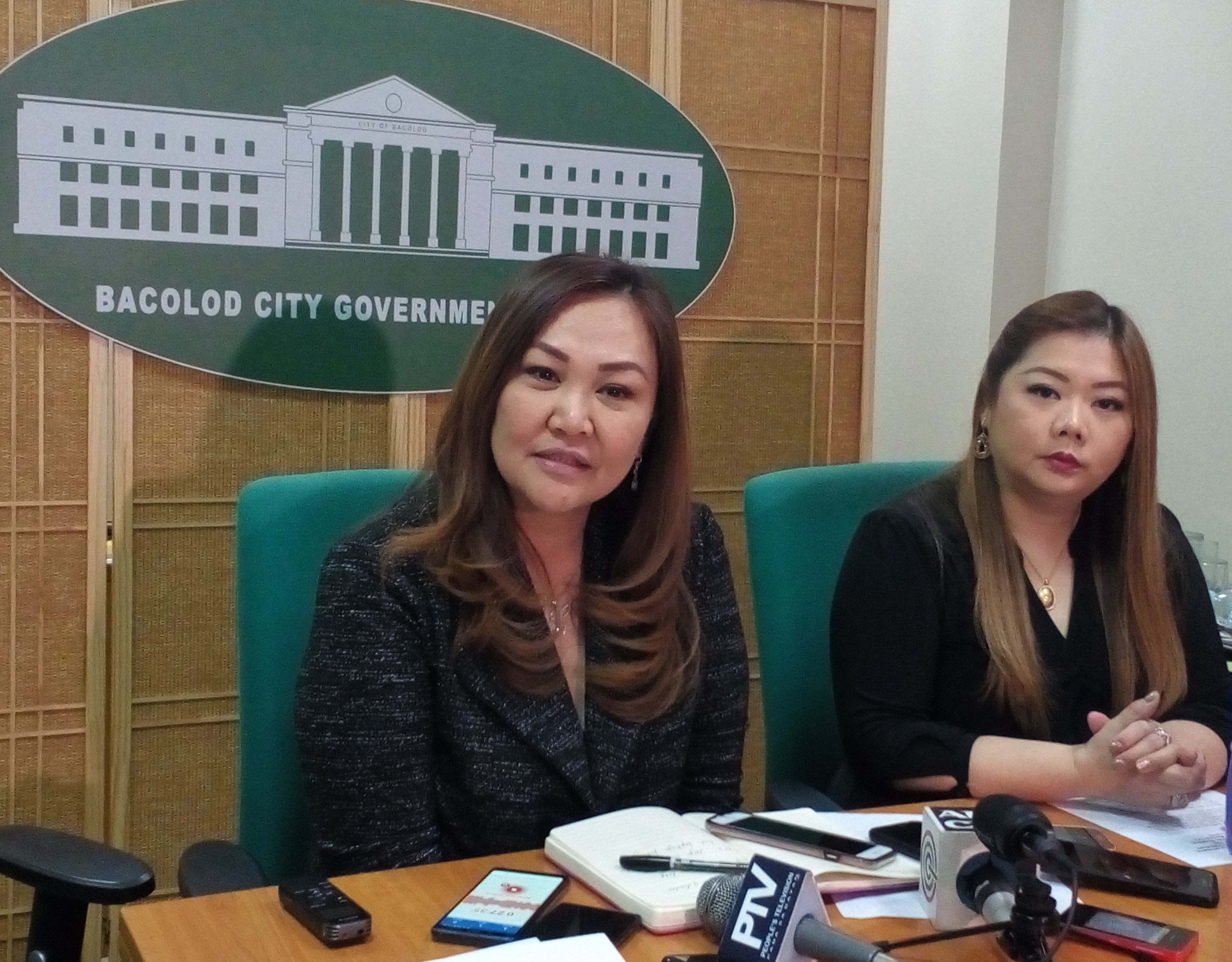
Bacolod City Councilors Em Ang (left) and Cindy Rojas give updates on their recent visit to Daegu Metropolitan City in South Korea to strengthen sister city ties with the Seogu District, in a press conference at the City Mayor’s Office on Wednesday afternoon (Feb. 13, 2019).  Photo by Nanette L. Guadalquiver

She said they met with former District Mayor Kang Seong-Ho, the signatory of the sister city agreement entered between Bacolod and Seogu in 2013, for exploratory talks on areas the two cities can collaborate.

Ang, who chairs the City Council’s committee on tourism, pointed out that Daegu has a lot of similarities to Bacolod such as big festivals closely tied to their economy.

“The biggest festival is the colorful Daegu Festival held every month of May and it is like our very own MassKara Festival. They also have Chemeck Festival, which is a chicken and beer festival. It is held every July. It is like our Inasal Festival,” she said.

Ang said that during their meeting with the former Mayor Kang, they discussed the possibility of the two cities engaging in cultural exchanges focusing on their festivals.
“They want to send to Bacolod their performers and at the same time, invited the MassKara dancers to come to their place,” she added.

Rojas said their trip was an educational tour and a benchmarking activity in the areas of tourism, culture, and trade.

She noted that she got interested in an art strip where a blank wall was made available for murals, which could also be done in Bacolod.

“It’s a row of walls which they dedicate to famous South Korean folk singer Kim Kwang-seok, like the Philippines’ Freddie Aguilar. We have areas in Bacolod which we can transform into this. We have so many gifted artists here,” Rojas said.

Moreover, Ang said they also see an opportunity for start-up companies in Bacolod to collaborate with companies in Daegu whose main industries are technology and automotive parts. (PNA)

Source: http://www.pna.gov.ph/articles/1061889

Transfer of NFA-NegOcc office to Bago City approved: DA chief

BACOLOD CITY — The transfer of the National Food Authority (NFA)-Negros Occidental provincial office here to Bago City has been approved by the NFA Council (NFAC).

Agriculture Secretary Emmanuel Piñol said in his Facebook post on Wednesday that the approval took place during the last meeting of the NFAC held in Malacañang.

The NFA’s new office and buying station will rise on a property beside the provincial government-owned rice processing complex, a facility supported by the Department of Agriculture (DA), located in Barangay Tabunan. The proposed site is about two hectares.


The present site of the National Food Authority-Negros Occidental provincial office
on Gatuslao Street, Bacolod City.
PNA Bacolod file photo

Piñol said Governor Alfredo Marañon Jr. himself formally requested the relocation of the NFA provincial office to Bago City from its current location on Gatuslao Street in Bacolod City.

He added that the provincial government has allocated PHP50 million for the construction of the NFA office building and grains silos.

“The transfer will be done as soon as the new office building is completed,” the DA chief added.

During his visit to Negros Occidental last October, Piñol inspected the proposed area in Barangay Tabunan, together with Provincial Agriculturist Japhet Masculino and NFA-Negros Occidental provincial manager Frisco Canoy.

“I found the place very good. If the NFA Council would approve it, and I think they would, the provincial government has agreed to construct a building for the NFA in the area,” Piñol said in a press conference with Marañon during that visit.

“From my perspective, I am asking why we should maintain a warehouse and office for a grains agency in the middle of the city. We should be where the rice fields are, where the rice farmers are,” he added.

For his part, Marañon earlier said he has been pushing for the transfer of the NFA provincial office for the grains agency to have more space.

He noted that the road beside the NFA building is part of the land sold by the provincial government to property giant Ayala Land Inc., which has ongoing developments in the area. (PNA)

Source: http://www.pna.gov.ph/articles/1061764

Negros Press Club seeks NBI probe of media ‘drug lists’

BACOLOD CITY — The Negros Press Club (NPC) has asked the National Bureau of Investigation (NBI) to trace the source of the alleged drug lists circulating on social media that included the names of at least 15 media practitioners here.

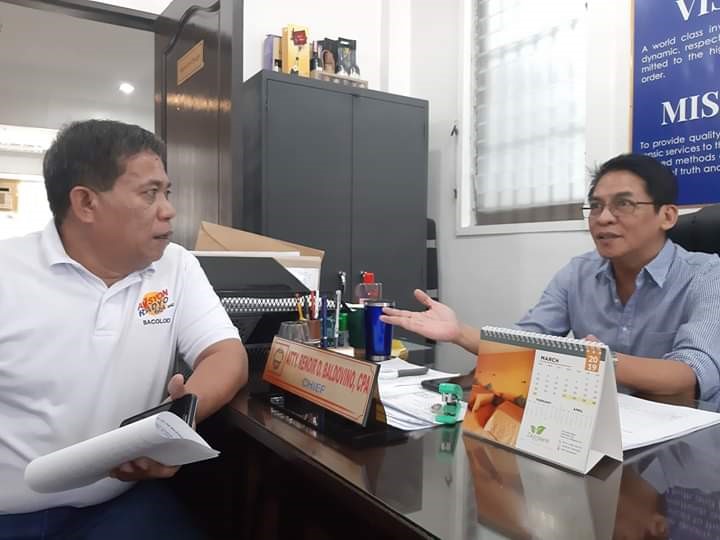
NPC president Renato Duran and other club officers met with NBI-Bacolod agent-in-charge Renoir Baldivino at the latter’s office on Wednesday after a third list was emailed to a local newspaper on Monday, following the previous two that were posted on Facebook.

Duran said Baldivino referred their concern to the Cybercrime Division of the NBI central office.


Negros Press Club president Renato Duran (left) meets with NBI-Bacolod agent-in-charge Renoir Baldivino on Wednesday )(Feb. 13, 2019) to ask for an investigation on the inclusion of local media practitioners in the alleged drug lists from unknown sources circulating on social media.
Photo courtesy of Dolly Yasa

He added that NPC officers will soon schedule a visit to the NBI in Manila.

The NPC and the National Union of Journalists of the Philippines (NUJP)-Bacolod issued a unity statement denouncing the release of the lists from unknown sources.

The names of the journalists were lumped with other local personalities in Negros Occidental and Bacolod City, including elected government officials.

“We, the members of the media community of Bacolod City and Negros Occidental denounce the malicious spreading through social media of anonymous lists of purported drug personalities, including at least 15 of our colleagues,” the NPC and the NUJP-Bacolod statement said.

Those included on the alleged lists are active media practitioners in Bacolod.

“The inconsistencies and seeming lack of logic in the composition of these lists indicate that these were drawn up by conflicting parties out to destroy each other while, at the same time, attempting to muddle their tracks by including random names, including our colleagues,” the statement added.

“This is unacceptable to us, not only as journalists but as citizens of this country who share and deserve to enjoy the rights guaranteed by our Constitution and the laws of the land. No one, and we mean no one, should be subjected to trial by publicity and, worse, punished without being accorded due process,” the groups’ statement added.

The two media organizations also said they demand that authorities “investigate and get the cowards and criminals responsible for creating and spreading these lists and prosecute them to the fullest extent of the law.”
“What they have done is a crime,” they said.

“We call on all members of the media community of Bacolod City and Negros Occidental to close ranks and defend our integrity even as we urge everyone to uphold the highest ethical and professional standards as we go about our work,” the statement added. (PNA)

Source: http://www.pna.gov.ph/articles/1061818

561 residents benefit from P11-M village road in south Negros

BACOLOD CITY — Some 561 residents in a remote village of Kabankalan City, Negros Occidental are benefiting from the PHP11.28-million road concreting project implemented by the Department of Public Works and Highways (DPWH).

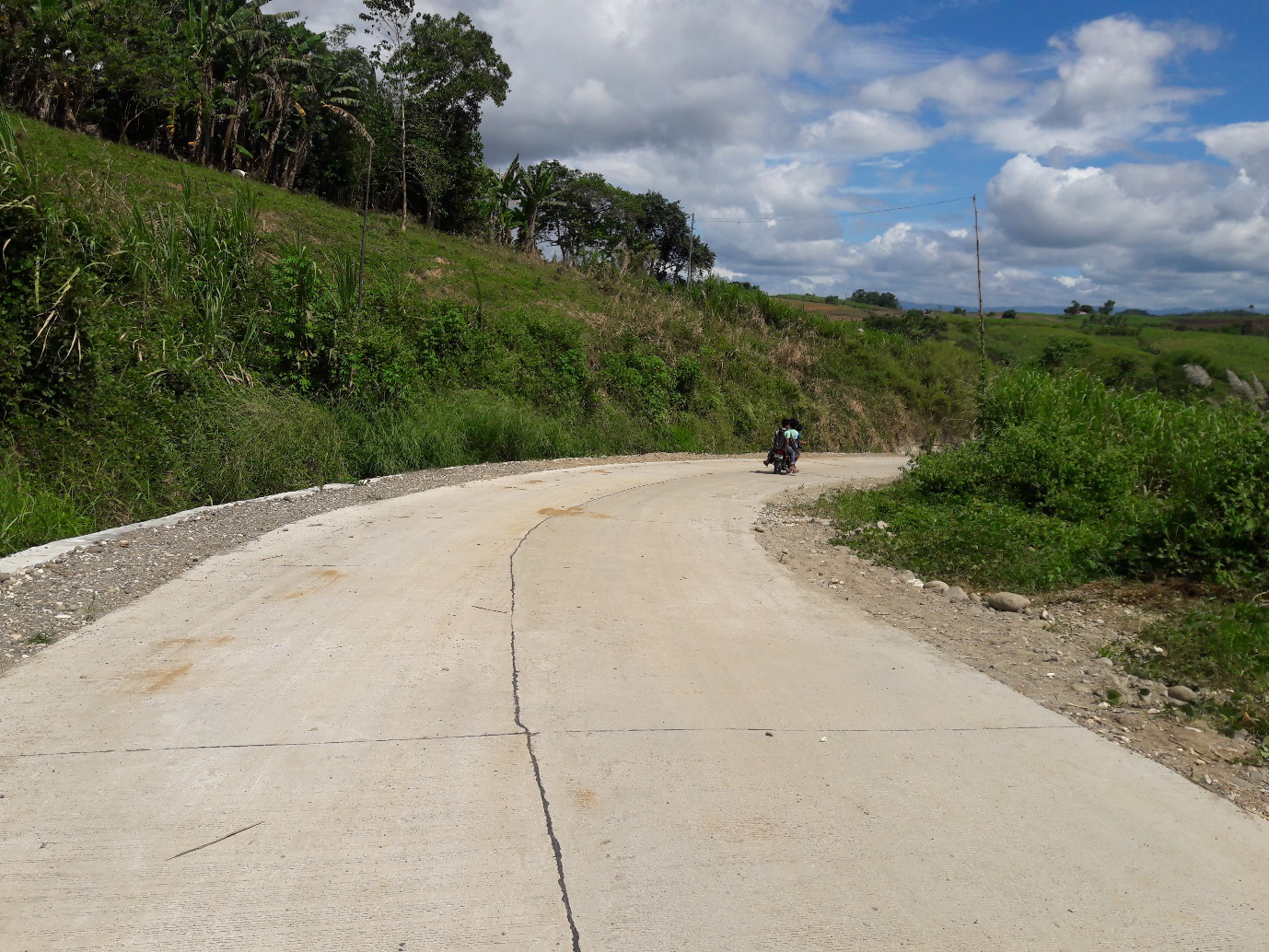
The newly-concreted road, constructed by Negros Occidental’s 3rd District Engineering Office, has provided a conducive and faster transport of goods and services for the people of Sitio Lowag in Barangay Locotan in Kabankalan City.

District Engineer Haydee Alunan, in a statement on Wednesday, said the project has been funded under the Payapa at Masaganang Pamayanan (PAMANA) program initiated by the Office of the Presidential Adviser on the Peace Process (OPAPP).


The newly-concreted road leading to Sitio Lowag in Barangay Locotan, Kabankalan City, Negros Occidental provides a conducive and faster transport of goods and services for the people living in the far-flung area.
Photo from DPWH Negros Occidental, Third District Engineering Office

“This is one of the infrastructure projects implemented to lessen the insurgency cases in winning the long-lasting peace process anchored on the PAMANA program,” Alunan said.

The project involves the concrete paving of 718 lineal meters of road with five-meter wide portland concrete cement pavement, including pipe culverts and grouted riprap.

Alunan said the project provides a better road network in isolated and vulnerable areas in Kabankalan City due to insurgency problems.

Last month, DPWH 6 (Western Visayas) also announced another project in southern Negros, the construction of an academic building at the Hinigaran National High School in Hinigaran town.

The project is being implemented by Negros Occidental’s 2nd District Engineering Office headed by District Engineer Randolfo Melosantos in convergence with the Department of Education.

Melosantos said earlier the PHP45.154-million project involves the construction of a four-story, 20-classroom building.

He added that the project is expected to be completed in August to serve the increasing number of senior high school students. (PNA)

Source: http://www.pna.gov.ph/articles/1061767

Stakeholders seek review of SIDA, PhilSuCor revival

MANILA — Sugar stakeholders ended their two-day summit Tuesday amid calls for a review as to how the Sugar Industry Development Act (SIDA) funds were spent as well as for revival of the Philippine Sugar Corporation (PhilSuCor).

Agriculture Secretary Emmanuel “Manny” Piñol, at the sidelines of the summit, said the meeting was called to discuss critical issues among which was the proposal to liberalize the sugar industry, and if that happens, “we would like the industry to be prepared.”

Among the proposals that stakeholders submitted, he said, was to review the utilization of SIDA funds.

“The feeling of the stakeholders the distribution of the SIDA funds were not focused on the needs of the industry. So, they came out with a resolution asking for a review and possible amendment of SIDA,” he said.

The stakeholders also passed a resolution asking the President to revive the Philippine Sugar Corporation (PhilSuCor).

“They (stakeholders) said they have difficulty to get loans from the Land Bank of the Philippines given the nature of the bank that is just following the guidelines issued by the Central Bank of the Philippines,” he said.

“They feel that PhilSuCor was more responsive to their needs. The release of loans would also be faster thru the PhilSuCor,” he added.

President Rodrigo Duterte has ordered the abolition of PhilSuCor, saying its function is no longer needed.

In his Memorandum Order No. 30 signed Oct. 25, the President said PhilSuCor is no longer needed as much of the financing needs of sugar mills are already being provided by private banking and financing institutions in addition to the lending facilities offered by the Development Bank of the Philippines and Land Bank of the Philippines.

PhilSuCor, a government-owned and controlled corporation (GOCC), was created on Nov. 14, 1983 primarily to provide financing in the acquisition, rehabilitation, and expansion of sugar mills, refineries, and other related facilities used in the manufacture, packing, storage, distribution, and shipment of sugar and its by-products and derivatives.

The stakeholders also submitted a position paper opposing the liberalization of the sugar industry, saying this will be detrimental to sugar farmers where 80 percent are land reform beneficiaries.

Confederation of Sugar Producers spokesman Raymond Montinola noted that unrestricted importation “will be disastrous for an industry that directly employs over 700,000 workers in 28 provinces, with another five million Filipinos dependent on it for their livelihood, as estimated by the Department of Agriculture and the Board of Investments.”

“Import liberalization will ruin the balance of domestic goods. Small farmers will be unable to make a decent living when prices dive below production cost. Sugar mills with billions of investments in the countryside will be bankrupted. Financial institutions will be unable to collect on loans, including the repayment of ARBs for distributed landholdings,” he said.

“The truth is these food processors/exporters are allowed to import sugar, subject of course to controls by the SRA. Last year, in fact, over 62,000 metric tons of sugar were allocated to that industry. Close monitoring by the SRA is crucial to prevent them from defrauding government of revenues as happened in the past when food processors leaked cheap imported sugar into the domestic market,” Montinola added.

Meanwhile, Piñol said the stakeholders also agreed that they should be competitive, that’s why they asked the government to have access to high yielding varieties.

The group also proposed that the solar irrigation project be extended to the sugar industry.

Sugar stakeholders also asked that summit be held at the DA on an annual basis or as the need arises, he added.

Piñol emphasized that the DA “would always be neutral in as far as decision is concerned.”

“We cannot take specific issues because we are part of the administration. Our role is to listen to them and relay whatever it is that they would like the President and the economic managers would like to listen to,” he said. (PNA)

Source: http://www.pna.gov.ph/articles/1061734

Bacolod sets up measles fast lanes; cases hit 53 since Jan. 1

BACOLOD CITY — The Bacolod City Health Office (CHO) is setting up fast lanes in barangay health centers to accommodate suspected measles patients as cases in the city reached 53 from January 1 to February 10 this year.

Dr. Maria Carmela Gensoli, city health officer, said in a press briefing on Monday that she would issue a memorandum within the day for all health centers to put in place their response to measles cases.

“I have instructed the health centers and the main dispensary for our measles fast lanes to prioritize those who have high-grade fever and rash for admission,” she said.


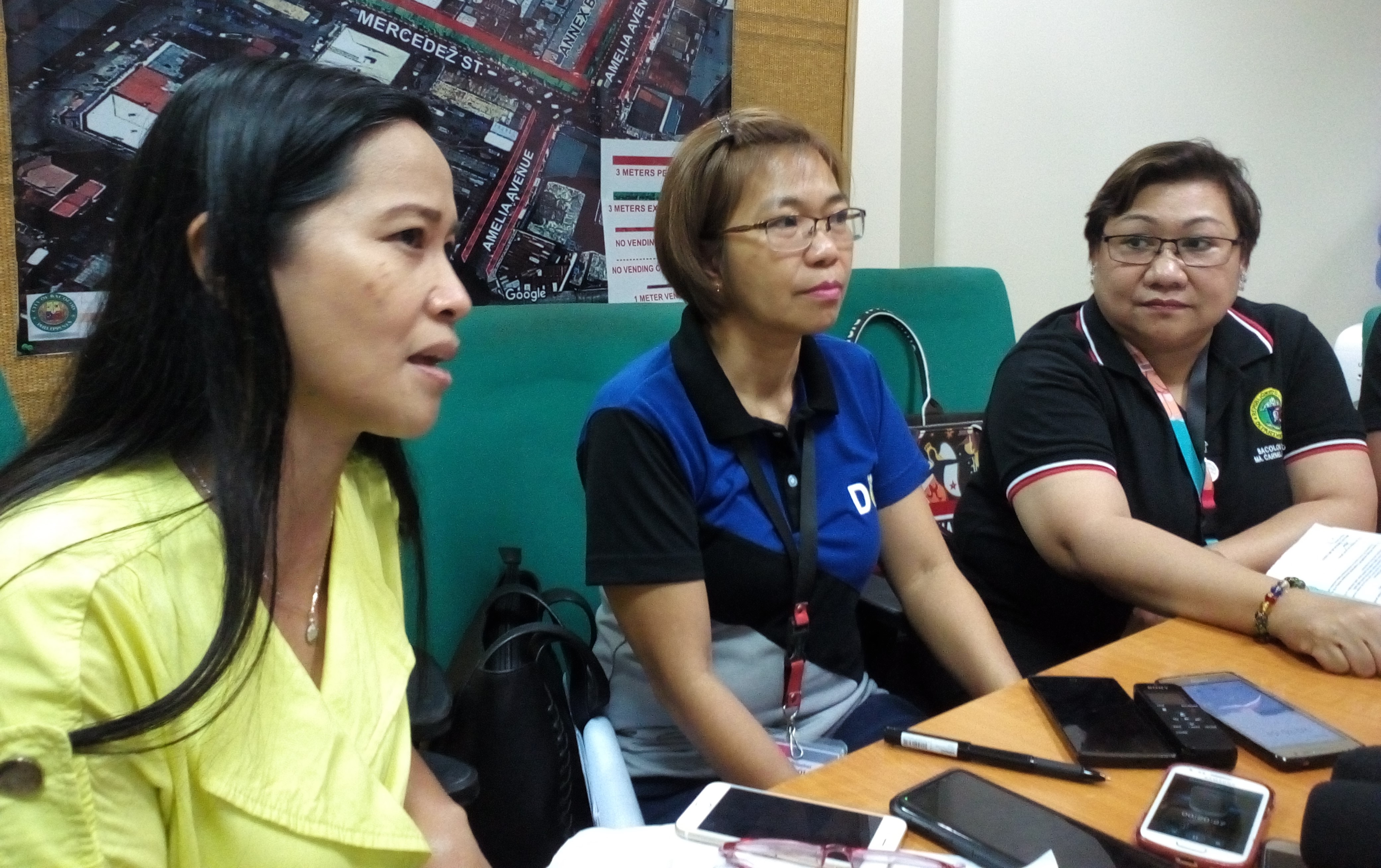
Dr. Ma. Carmela Gensoli (right), city health officer; Dr. Grace Tan (center), head of Environment Sanitation Division; and Dr. Rosalie De Ocampo, medical coordinator of National Immunization Program, give updates on the anti-measles campaign of the Bacolod City Health Office, in a press briefing at the City Mayor’s Office on Monday, Feb. 11, 2019. Photo by Nanette L. Guadalquiver
 

Records showed the 53 suspected measles cases include patients between three months and 45 years old recorded in the first six weeks of 2019. Last year, the CHO started receiving reports of measles cases only in March.

Since January 1 this year, suspected measles cases have been reported in the city’s 22 villages.

Seven cases were reported in Barangay Taculing while six were monitored in Barangay Mansilingan. Barangays 14 and Bata had four cases each while Barangays 35, Alijis, Estefania, Handumanan and Granada had three each. Barangays Villamonte, Vista Alegre, Singcang-Airport and Tangub had two cases each.    

Nine other villages reported one case each.

Dr. Grace Tan, head of CHO Environment Sanitation Division, said the city government has sufficient anti-measles vaccines for the target age-groups.

“Measles is a vaccine-preventable disease, which means it can be prevented through immunization and no other else,” Tan said.

Target groups include infants aged six, nine and 12 months who can be brought to the barangay health centers for free measles, mumps and rubella (MMR) immunization every Wednesday.

Those not included in these age-groups such as children above one-year-old and below five years old, and school children in Grades 1 and 7, who missed the school-based immunization, can also visit the health centers for their anti-measles shots.  

“Just bring them to the health centers. We still have available vaccines for them,” Tan said.

For those who prefer to be immunized in private medical clinics, they can get a shot of MMR vaccine for PHP1,300 to PHP1,500.

Dr. Rosalie Deocampo, medical coordinator of National Immunization Program, said the CHO also conducted a door-to-door measles vaccination in November and December last year for infants and children aged six months to 59 months. 

“We covered them since they are expected to be the most vulnerable,” Deocampo said. (PNA)

Source: http://www.pna.gov.ph/articles/1061602

Dengue cases in Bacolod City up by 121%

BACOLOD CITY — Cases of dengue fever in Bacolod City increased by almost 121 percent in the first five weeks of 2019, City Health Office (CHO) records showed.

Dr. Grace Tan, head of CHO Environment Sanitation Division, said on Monday that from January 1 to February 5, they have recorded a total of 201 cases, including one death, compared to only 91 during the same period last year.

“We are still advocating for ‘search and destroy’ of all probable mosquito breeding and nesting places both in and out of houses, buildings and other areas,” she said.

Tan said it is still the people who primarily need to participate in the dengue prevention campaign, “Don’t wait for the local government or the City Health Office to go to you,” she added.

Tan said although dengue cases peak during rainy months, cases are also reported in other months of the year.

“Based on our previous data, 2019 has been predicted as a year where dengue cases will increase if we don’t do something about it,” she added.

Dengue cases usually spike every three years. In 2016, the CHO recorded 2,180 cases, but cases decreased in 2017 (1,965) and 2018 (1,493). In 2013, cases in Bacolod reached 3,300 while in 2010, it was 4,278.

Thus, dengue cases are expected to increase anew this 2019.

In Bacolod, dengue cases were reported in 34 of the city’s 61 barangays from January 1 to February 2.

Handumanan has the highest number of cases at 17. Tangub and Estefania have 15 each; Pahanocoy and Singcang-Airport, 14 each; Mansilingan, 13; Granada, 12; Sum-ag and Mandalagan, 10 each; Bata and Taculing, nine each; Villamonte, seven; Banago and Alijist, six each; Barangay 35, five; Barangays 2, 40 and Felisa, four each; Barangays 1, 16, Alangilan, Vista Alegre, and Cabug, three each; and Barangay 7, two.

Barangays 3, 4, 6, 11, 13, 19, 30, 31, 39 and Punta Taytay have once each. (PNA)

Source: http://www.pna.gov.ph/articles/1061650

P1.875-M worth of ‘shabu’ seized in Bacolod buy-bust

BACOLOD CITY — Two persons were arrested while PHP1.875-million worth of suspected shabu were confiscated by police operatives in a buy-bust in Purok Riverside, Barangay Banago here over the weekend, police reported on Sunday.

The operation, conducted by personnel of Police Station 3 at about 5 a.m. on Saturday, led to the arrest of Randy Benjamin, 39, and Jamil Equital, 22. Another suspect, Leoner Jalando-on, 35, fled.


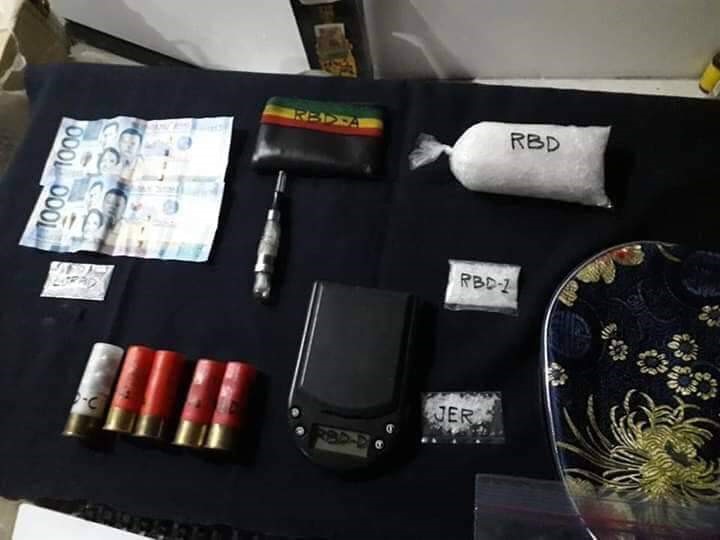
Operatives of Police Station 3 of the Bacolod City Police Office seize PHP1.875 million worth of suspected shabu along with drug paraphernalia and live ammunition of a 12-gauge shotgun during a raid over the weekend at Purok Riverside, Barangay Banago.
Photo courtesy of DYHB Tatak RMN Page

Benjamin, a former village watchman, sold PHP2,000 worth of shabu to an undercover policeman. Equital was identified as his runner.

The suspects also yielded about 150 grams of the prohibited substance along with drug paraphernalia and five live ammunition of a 12-gauge shotgun.

In an interview, Chief Insp. Ruel Culanag, head of Police Station 3, said Benjamin, a newly-identified drug personality, sources his illegal drug supply from Metro Manila and is believed to be a distributor in nearby localities.

Also at about 10 p.m. on Saturday, operatives of Police Station 7 arrested two persons in a buy-bust operation in Purok Cabuguason, Barangay Mansilingan here.

Bernadette Prado, 36, and Jeric John Medel, 23, were found in possession of PHP7,000 worth of suspected shabu after selling PHP500 of the prohibited substance to a police poseur-buyer. (PNA)

Source: http://www.pna.gov.ph/articles/1061512