NegOcc cassava farmers receive P3-M in equipment

BACOLOD CITY — A group of cassava farmers in Moises Padilla, Negros Occidental received PHP3 million worth of farm machines from the Department of Agriculture (DA).

The pieces of equipment, which include a four-wheel tractor, a cassava chipper, and three units of water pump, are expected to boost the farmers’ production capacity.

Provincial Agriculturist Japhet Masculino, who led the turn-over rites in Barangay Odiong on Thursday, said a huge part of the 30-hectare contiguous farm being cultivated by the Barangay Odiong Cassava Farmers Association is devoted to food-grade variety of cassava.
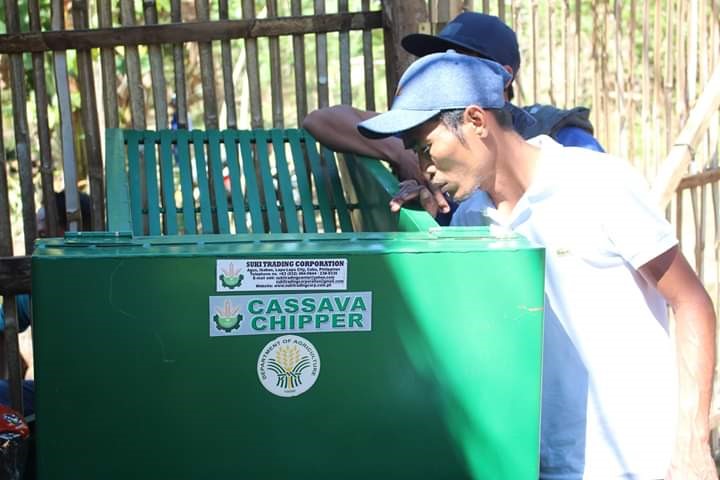

One of the machines received by the Barangay Odiong Cassava Farmers Association in Moises Padilla, Negros Occidental from the Department of Agriculture-Western Visayas under the agency’s cassava development program.
Contributed photo

“The machines would help the recipient-farmers, who are agrarian reform beneficiaries, especially in the land preparation,” he said.

Masculino added that the pieces of equipment can also help the organization generate income through custom plowing, or allowing non-member farmers or associations subject to rental fee.

The support services given to the Barangay Odiong Cassava Farmers Association is provided by the DA-Western Visayas under its cassava development program, through the assistance of the Office of the Provincial Agriculturist (OPA) and the Municipal Agriculture Office (MAO).

The Barangay Odiong Cassava Farmers Association, comprised of 36 farmer-members, delivers up to 30 sacks of fresh cassava twice a week to an institutional buyer in Bacolod City.

Their area is considered a model farm as they were able to sustain the production on top, having the largest contiguous area devoted to cassava in the province.

Through the machines, OPA hopes the association can also fully utilize the entire area for cassava production, Masculino said,

He noted that although the project is a dole-out, the OPA will still monitor the implementation, specifically to determine whether the equipment have helped boost productivity and profitability of the association.

Masculino said they also recognized the need of the farmers for additional interventions, including livelihood projects like free-range chicken dispersal and value-adding trainings.

“Value-adding interventions include processing of cassava cake, flour and other cassava-based products as sources of additional income and livelihood,” he added.

The OPA chief said the farmers can be introduced to a credit facility through the Production Loan Easy Access program, mainly for additional capital. (PNA)


Source: http://www.pna.gov.ph/articles/1062015

Transfer of NFA-NegOcc office to Bago City approved: DA chief

BACOLOD CITY — The transfer of the National Food Authority (NFA)-Negros Occidental provincial office here to Bago City has been approved by the NFA Council (NFAC).

Agriculture Secretary Emmanuel Piñol said in his Facebook post on Wednesday that the approval took place during the last meeting of the NFAC held in Malacañang.

The NFA’s new office and buying station will rise on a property beside the provincial government-owned rice processing complex, a facility supported by the Department of Agriculture (DA), located in Barangay Tabunan. The proposed site is about two hectares.


The present site of the National Food Authority-Negros Occidental provincial office
on Gatuslao Street, Bacolod City.
PNA Bacolod file photo

Piñol said Governor Alfredo Marañon Jr. himself formally requested the relocation of the NFA provincial office to Bago City from its current location on Gatuslao Street in Bacolod City.

He added that the provincial government has allocated PHP50 million for the construction of the NFA office building and grains silos.

“The transfer will be done as soon as the new office building is completed,” the DA chief added.

During his visit to Negros Occidental last October, Piñol inspected the proposed area in Barangay Tabunan, together with Provincial Agriculturist Japhet Masculino and NFA-Negros Occidental provincial manager Frisco Canoy.

“I found the place very good. If the NFA Council would approve it, and I think they would, the provincial government has agreed to construct a building for the NFA in the area,” Piñol said in a press conference with Marañon during that visit.

“From my perspective, I am asking why we should maintain a warehouse and office for a grains agency in the middle of the city. We should be where the rice fields are, where the rice farmers are,” he added.

For his part, Marañon earlier said he has been pushing for the transfer of the NFA provincial office for the grains agency to have more space.

He noted that the road beside the NFA building is part of the land sold by the provincial government to property giant Ayala Land Inc., which has ongoing developments in the area. (PNA)

Source: http://www.pna.gov.ph/articles/1061764

Stakeholders seek review of SIDA, PhilSuCor revival

MANILA — Sugar stakeholders ended their two-day summit Tuesday amid calls for a review as to how the Sugar Industry Development Act (SIDA) funds were spent as well as for revival of the Philippine Sugar Corporation (PhilSuCor).

Agriculture Secretary Emmanuel “Manny” Piñol, at the sidelines of the summit, said the meeting was called to discuss critical issues among which was the proposal to liberalize the sugar industry, and if that happens, “we would like the industry to be prepared.”

Among the proposals that stakeholders submitted, he said, was to review the utilization of SIDA funds.

“The feeling of the stakeholders the distribution of the SIDA funds were not focused on the needs of the industry. So, they came out with a resolution asking for a review and possible amendment of SIDA,” he said.

The stakeholders also passed a resolution asking the President to revive the Philippine Sugar Corporation (PhilSuCor).

“They (stakeholders) said they have difficulty to get loans from the Land Bank of the Philippines given the nature of the bank that is just following the guidelines issued by the Central Bank of the Philippines,” he said.

“They feel that PhilSuCor was more responsive to their needs. The release of loans would also be faster thru the PhilSuCor,” he added.

President Rodrigo Duterte has ordered the abolition of PhilSuCor, saying its function is no longer needed.

In his Memorandum Order No. 30 signed Oct. 25, the President said PhilSuCor is no longer needed as much of the financing needs of sugar mills are already being provided by private banking and financing institutions in addition to the lending facilities offered by the Development Bank of the Philippines and Land Bank of the Philippines.

PhilSuCor, a government-owned and controlled corporation (GOCC), was created on Nov. 14, 1983 primarily to provide financing in the acquisition, rehabilitation, and expansion of sugar mills, refineries, and other related facilities used in the manufacture, packing, storage, distribution, and shipment of sugar and its by-products and derivatives.

The stakeholders also submitted a position paper opposing the liberalization of the sugar industry, saying this will be detrimental to sugar farmers where 80 percent are land reform beneficiaries.

Confederation of Sugar Producers spokesman Raymond Montinola noted that unrestricted importation “will be disastrous for an industry that directly employs over 700,000 workers in 28 provinces, with another five million Filipinos dependent on it for their livelihood, as estimated by the Department of Agriculture and the Board of Investments.”

“Import liberalization will ruin the balance of domestic goods. Small farmers will be unable to make a decent living when prices dive below production cost. Sugar mills with billions of investments in the countryside will be bankrupted. Financial institutions will be unable to collect on loans, including the repayment of ARBs for distributed landholdings,” he said.

“The truth is these food processors/exporters are allowed to import sugar, subject of course to controls by the SRA. Last year, in fact, over 62,000 metric tons of sugar were allocated to that industry. Close monitoring by the SRA is crucial to prevent them from defrauding government of revenues as happened in the past when food processors leaked cheap imported sugar into the domestic market,” Montinola added.

Meanwhile, Piñol said the stakeholders also agreed that they should be competitive, that’s why they asked the government to have access to high yielding varieties.

The group also proposed that the solar irrigation project be extended to the sugar industry.

Sugar stakeholders also asked that summit be held at the DA on an annual basis or as the need arises, he added.

Piñol emphasized that the DA “would always be neutral in as far as decision is concerned.”

“We cannot take specific issues because we are part of the administration. Our role is to listen to them and relay whatever it is that they would like the President and the economic managers would like to listen to,” he said. (PNA)

Source: http://www.pna.gov.ph/articles/1061734

Negros Occidental to pursue sorghum production

BACOLOD CITY — The provincial government of Negros Occidental is embarking on the production of sorghum this year, mainly as an alternative crop for silage and feeds.

Provincial Agriculturist Japhet Masculino bared the plan on Sunday after he and Gov. Alfredo Marañon Jr. met with Agriculture Secretary Emmanuel Piñol in North Cotabato over the weekend.

Piñol has pushed for the production of sorghum in Negros Occidental when he toured the provincial officials at the sorghum model farm in Makilala town.


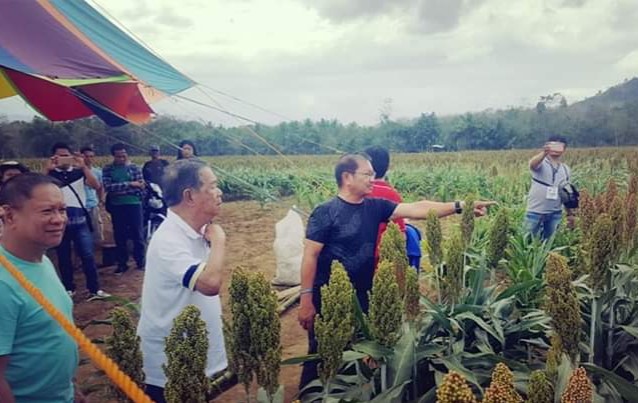
Agriculture Secretary Emmanuel Piñol (3rd from left) tours Negros Occidental Governor Alfredo Marañon Jr. (2nd from left) and Provincial Agriculturist Japhet Masculino (left) at the sorghum model farm in Makilala, North Cotabato on Saturday.
Contributed photo

Masculino said the agriculture chief told them that sorghum is a crop worth considering for two major benefits — income for the farmers from feeds and source of silage for livestock.

“Secretary Piñol assured that market is available for sorghum and he will provide Negros Occidental with hybrid seeds,” he said.

Masculino added that sorghum is promising as a feed ingredient and its production is very suitable for the province.

Sorghum, which can be rationed (to sprout or spring up from the root) three times in a year, is considered a versatile crop that can be grown as a grain, forage or sweet crop.

In Negros Occidental, there are some sorghum plantations producing the crop, primarily as sources of raw materials for bioethanol production.

Masculino said the Office of the Provincial Agriculturist will start the initiative on sorghum production this year.

“We have to set up a model farm at the earliest,” he added.

With the huge demand from the local livestock industry, the provincial government will venture into sorghum production – mainly for feeds and silage since Negros Occidental lacks feed ingredients which can be an alternative to corn.

Masculino said the provincial government is eyeing a 10-hectare portion of the Capitol-owned property at Paglaum Village in Barangay Mansilingan, Bacolod City as a model farm.

“It will be a province-led production initiative for the meantime. In terms of market, we can eventually tap our local feed producers,” he added. (PNA)

Source: http://www.pna.gov.ph/articles/1060911