Labor unions lead signature drive vs. sugar import liberalization

BACOLOD CITY — The National Congress of Unions in the Sugar Industry of the Philippines (Nacusip) is leading a nationwide campaign that aims to gather one million signatures to strongly oppose the proposed liberalization of sugar imports.

Nacusip national president Roland De la Cruz said in a telephone interview on Monday that the signature campaign is an initiative of the workers’ unions to protect the sugar industry.

“This is not just about the sugar industry of Negros Occidental, but the sugar industry of the Philippines as a whole,” the labor leader said.


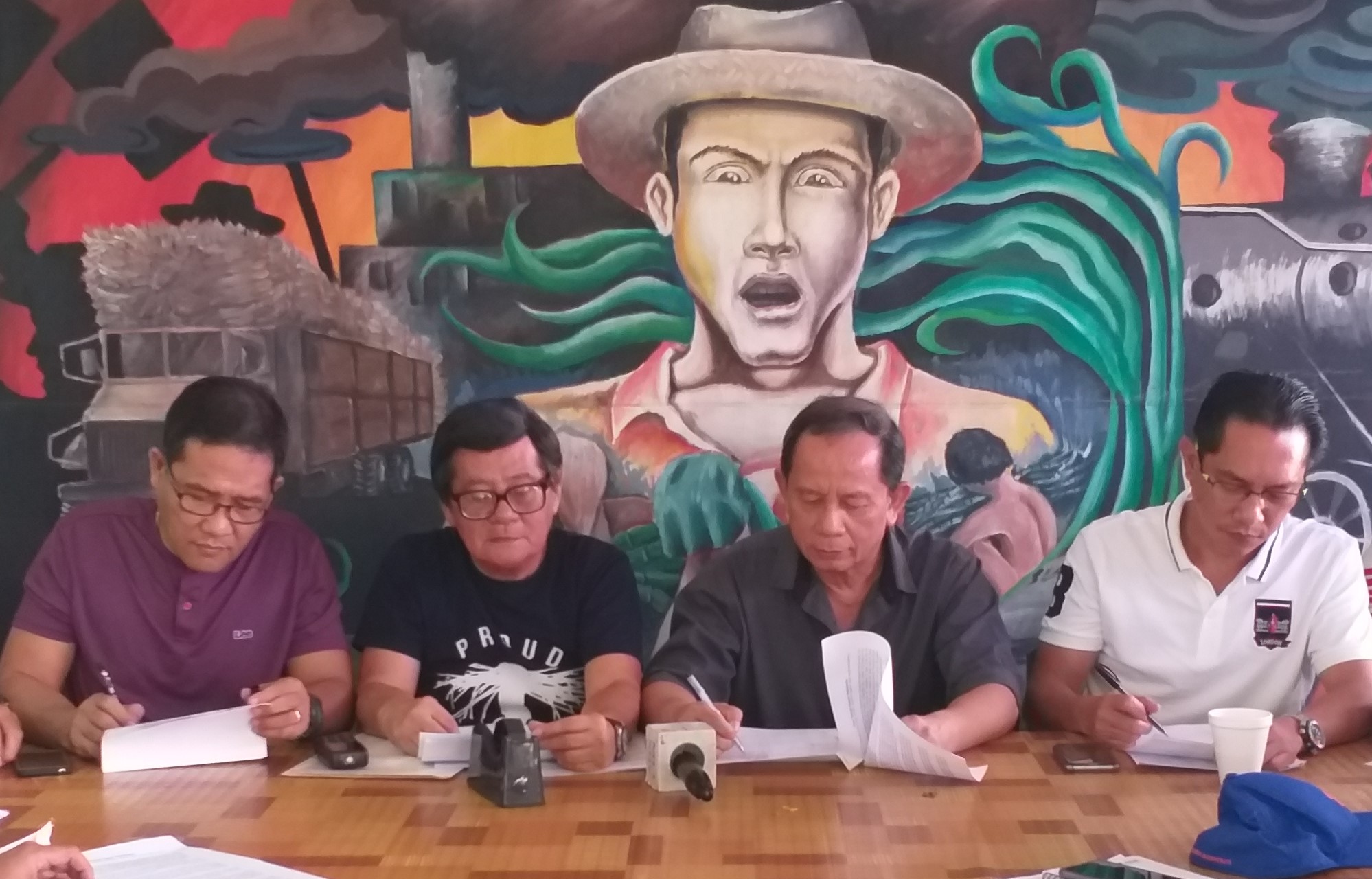
National Congress of Unions in the Sugar Industry of the Philippines national president Roland De la Cruz (seated, right) and officials of allied labor organizations launch the signature campaign strongly opposing the proposed liberalization of sugar imports in Bacolod City on Saturday, Feb. 23, 2019.
Contributed photo

This is the result of the various efforts of the industry sectors after the Sugar Summit spearheaded by the Sugar Regulatory Administration and the Department of Agriculture earlier this month, he added.

De la Cruz and officials of the Philippine Agricultural, Commercial and Industrial Workers Union (Paciwu), Congress of Independent Organizations (CIO), and Fraternal Labor Organizations (FLO) launched the campaign in a gathering held in this city on Saturday.

They were the first signatories to the open letter addressed to President Rodrigo Duterte, which they dubbed as a call and appeal from the workers, citizens, and families who are dependent on the sugar industry.

“We hope the President will get the pulse of the industry before finally deciding on the proposal. There is a big chain of interconnectivity here,  if the sugar industry gets killed, everything else will follow,” de la Cruz said.

He added that their action is not just confined in Negros Occidental, the country’s top sugar producer, since the industry also includes other regions in Luzon, Visayas and Mindanao.  

De la Cruz said that in Bacolod, they launched the English and Hiligaynon versions of the open letter, and they will soon come up with a Tagalog version.

“We are looking that after three months, we can submit the open letter to the President along with the signatures we have gathered,” he added.

In the open letter, they called on the government and the President “to junk and totally discard the proposal to liberalize the importation of sugar.” 

They pointed out that “unrestricted sugar importation” will “cause closures of sugar mills, massive dislocation and retrenchment of workers, and widespread unemployment of workers and farmers.” 

“The entry of imported cheap sugar from abroad with regulation and safety nets will destroy the sugar industry, our economy and the future of our children as well as the welfare of all the citizens of this province and of the whole country,” they added.

“We represent the workers and the citizens who are directly and indirectly dependent on the sugar industry, those who are working in the sugar mills, sugar farms and to those families who will be affected by the liberalization of sugar imports,” the groups further said.

Budget Secretary Benjamin Diokno earlier said that while the planned liberalization of sugar imports would negatively affect local producers, this would benefit a greater number of consumers.

He added that the plan to import some 200,000 metric tons of sugar seeks to address the elevated domestic inflation rate last year caused by supply-side factors, such as the lack of supply of rice, meat, and several other agricultural products. (PNA)
Source: http://www.pna.gov.ph/articles/1062879

Stakeholders seek review of SIDA, PhilSuCor revival

MANILA — Sugar stakeholders ended their two-day summit Tuesday amid calls for a review as to how the Sugar Industry Development Act (SIDA) funds were spent as well as for revival of the Philippine Sugar Corporation (PhilSuCor).

Agriculture Secretary Emmanuel “Manny” Piñol, at the sidelines of the summit, said the meeting was called to discuss critical issues among which was the proposal to liberalize the sugar industry, and if that happens, “we would like the industry to be prepared.”

Among the proposals that stakeholders submitted, he said, was to review the utilization of SIDA funds.

“The feeling of the stakeholders the distribution of the SIDA funds were not focused on the needs of the industry. So, they came out with a resolution asking for a review and possible amendment of SIDA,” he said.

The stakeholders also passed a resolution asking the President to revive the Philippine Sugar Corporation (PhilSuCor).

“They (stakeholders) said they have difficulty to get loans from the Land Bank of the Philippines given the nature of the bank that is just following the guidelines issued by the Central Bank of the Philippines,” he said.

“They feel that PhilSuCor was more responsive to their needs. The release of loans would also be faster thru the PhilSuCor,” he added.

President Rodrigo Duterte has ordered the abolition of PhilSuCor, saying its function is no longer needed.

In his Memorandum Order No. 30 signed Oct. 25, the President said PhilSuCor is no longer needed as much of the financing needs of sugar mills are already being provided by private banking and financing institutions in addition to the lending facilities offered by the Development Bank of the Philippines and Land Bank of the Philippines.

PhilSuCor, a government-owned and controlled corporation (GOCC), was created on Nov. 14, 1983 primarily to provide financing in the acquisition, rehabilitation, and expansion of sugar mills, refineries, and other related facilities used in the manufacture, packing, storage, distribution, and shipment of sugar and its by-products and derivatives.

The stakeholders also submitted a position paper opposing the liberalization of the sugar industry, saying this will be detrimental to sugar farmers where 80 percent are land reform beneficiaries.

Confederation of Sugar Producers spokesman Raymond Montinola noted that unrestricted importation “will be disastrous for an industry that directly employs over 700,000 workers in 28 provinces, with another five million Filipinos dependent on it for their livelihood, as estimated by the Department of Agriculture and the Board of Investments.”

“Import liberalization will ruin the balance of domestic goods. Small farmers will be unable to make a decent living when prices dive below production cost. Sugar mills with billions of investments in the countryside will be bankrupted. Financial institutions will be unable to collect on loans, including the repayment of ARBs for distributed landholdings,” he said.

“The truth is these food processors/exporters are allowed to import sugar, subject of course to controls by the SRA. Last year, in fact, over 62,000 metric tons of sugar were allocated to that industry. Close monitoring by the SRA is crucial to prevent them from defrauding government of revenues as happened in the past when food processors leaked cheap imported sugar into the domestic market,” Montinola added.

Meanwhile, Piñol said the stakeholders also agreed that they should be competitive, that’s why they asked the government to have access to high yielding varieties.

The group also proposed that the solar irrigation project be extended to the sugar industry.

Sugar stakeholders also asked that summit be held at the DA on an annual basis or as the need arises, he added.

Piñol emphasized that the DA “would always be neutral in as far as decision is concerned.”

“We cannot take specific issues because we are part of the administration. Our role is to listen to them and relay whatever it is that they would like the President and the economic managers would like to listen to,” he said. (PNA)

Source: http://www.pna.gov.ph/articles/1061734

Negrense groups protest proposed sugar import liberalization

BACOLOD CITY — More groups in Negros Occidental have manifested their protest to the proposed liberalization of sugar imports.

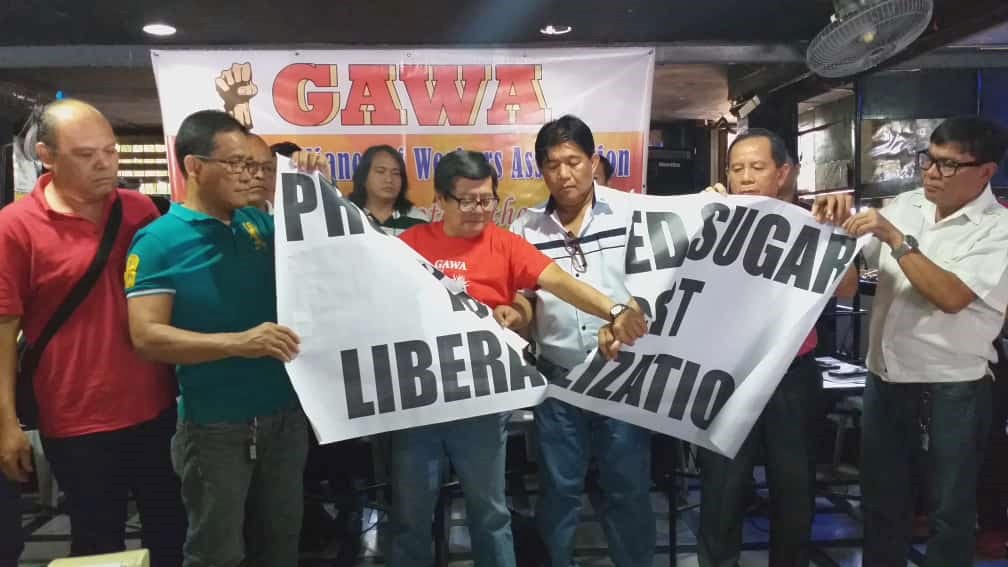
Leaders of the Solidarity of Workers in the Sugar Industry (SWSI) and the Save the Sugar Industry Movement (SSIM) expressed their opposition by tearing a replica of the proposal in a forum held at Gerald’s Restobar here on Thursday.

SSIM convenor Wennie Sancho said the tearing of the replica, which is a wide piece of paper with a text that read “Proposed Sugar Import Liberalization,” emphasizes their crusade against government economic managers’ proposed “deadly” policy.


Save the Sugar Industry Movement convenor Wennie Sancho (3rd from left) leads the symbolic tearing of the sugar import liberalization replica during a forum of labor groups in Bacolod City on Thursday (Feb. 7, 2019).
Photo by Erwin P. Nicavera

“If we wait for this sugar import liberalization to materialize, we would have waited too long. We must confront the worst threat before they emerge,” Sancho added.

“The only path for the survival of the sugar industry is the path to action. Let us protect sugar and save Negros by action,” he added.

The statement of solidarity released by SSIM and SWSI stated that advocates and multi-sectoral cause-oriented leaders from different labor organizations in Negros Occidental condemn in the strongest possible terms the proposed measure as it would obliterate the local sugar industry displacing thousands of sugar workers and their families.

They added that a disaster would come upon like an overwhelming flood, if the sugar industry will collapse as a result of sugar import deregulation.

“It is our right and our moral duty to oppose sugar import liberalization because the anticipated economic damage, if not prevented, would be greater and dangerous,” the groups added.

Meanwhile, the Sugar Farmers Federation-Kilusang Pagbabago — composed of 11 associations in Negros Occidental — said in a statement the country’s economic managers, who are pushing for the sugar imports liberalization, should know their place in policy-making.

“We campaigned and voted for President Rodrigo Duterte to lead us and make decisions for our nation. We did not vote for you, economic managers, so you don’t have the right to make decisions or proposals which will affect us, the 5 million Filipinos who depend on the sugar industry for our livelihood,” the group’s chairman Aaron Sorbito said.

“Our marginal farmers, mostly agrarian reform beneficiaries, need government support to lower cost of production and increase yields, not import liberalization,” he added.

On Wednesday, the Senate passed a resolution urging the Executive Department not to pursue the plan to liberalize the sugar industry to safeguard the economy and welfare of sugar farmers and workers in 28 provinces in the country, including Negros Occidental.

Economic managers of the administration earlier proposed the liberalization of sugar imports due to high prices of local sugar against those in the world market and that the same affects the competitiveness of sugar-containing food products for export.

Budget Secretary Benjamin Diokno earlier said that a 30 percent to 40 percent tariff rate is being eyed on sugar importation. (PNA)

Source: http://www.pna.gov.ph/articles/1061298

Sugar industry leaders laud senators’ support vs. import liberalization

BACOLOD CITY — Sugar industry leaders lauded the move of the 10 senators to support their campaign against the proposed liberalization of sugar imports.

On Wednesday, the Senate passed a resolution urging the Executive Department not to pursue the plan to liberalize the sugar industry to  safeguard the economy and welfare of sugar farmers and workers in 28 provinces in the country, including Negros Occidental.

Sugar Regulatory Administration Board Member Emilio Yulo III, who represents the planters, expressed his thanks to the senators who closed ranks with them.

He said the support shows that the senators understand the plight of the sugar industry and its stakeholders, adding that the Senate has always been their ally when it comes to protecting the industry.


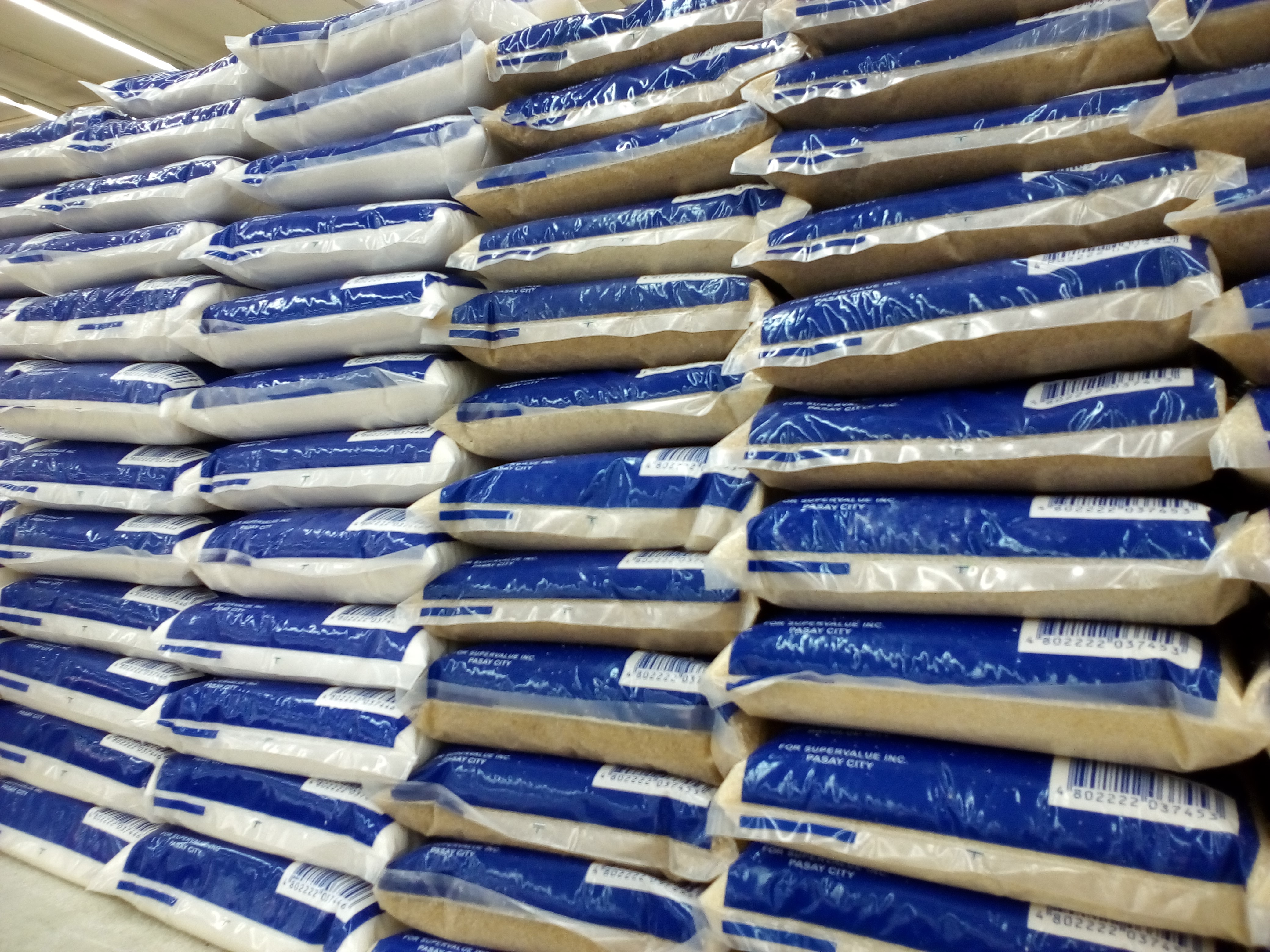
Sugar sold in retail at a supermarket in Bacolod City.
Photo by Nanette L. Guadalquiver

“We know that the battle is far from over but this Senate resolution gives us a glimmer of hope that not all is lost,” Yulo said.

The Confederation of Sugar Producers (Confed) also welcomed the development, saying the senators are right in stressing that the planned liberalization of the economic managers can lead to the demise of the sugar industry.

Confed spokesperson Raymond Montinola said in a statement the lawmakers righteously pointed out that the measure can result in a tumultuous peace and order situation.

Montinola said the senators who pushed for the resolution have been with the industry in the last three years from the time of the fight against the entry of high fructose corn syrup (HFCS) to the sugar taxation.

“Again, we are facing the threat of liberalization. That is also why we should always remember who our allies are and who has our backs,” he added.

Montinola also said the sugar industry will continue to be vigilant and seek the intervention of President Rodrigo Duterte to ensure that the plans of the economic managers will never be implemented.

The Senate resolution was introduced and adopted by 10 legislators, including Senators Juan Edgardo Angara, Nancy Binay, Joseph Victor Ejercito, Sherwin Gatchalian, Richard Gordon, Loren Legarda, Aquilino Pimentel III, Joel Villanueva, Cynthia Villar and Juan Miguel Zubiri.

The resolution cited reports that economic managers proposed the sugar import liberalization due to high prices of local sugar against those in the world market and that the same affects the competitiveness of sugar-containing food products for exports.

“The deregulated entry of subsidized sugar in the Philippine market will be disastrous to our sugar industry which contributes about PHP96 billion to the country’s Gross Domestic Product (GDP),” the resolution stated.

It aded that the sugar industry comprises some 84,000 farmers, mostly small ones and agrarian reform beneficiaries (ARBs), and 720,000 industry workers directly affecting almost a million families or five million individuals.

Budget Secretary Benjamin Diokno had earlier said there is a need to “relax” the rules on importation that puts pressure on the domestic economy to compete with the rest of the world.*

Workers’ groups launch manifesto vs. sugar import liberalization

BACOLOD CITY — Three labor groups launched a manifesto expressing their opposition to the liberalization of sugar imports, a proposal that has been met with protests by sugar industry stakeholders in Negros Occidental since last month.

The position paper, titled “The Karga-Tapas Manifesto”, was signed by leaders of the General Alliance of Workers Associations (GAWA), Philippine Agricultural, Commercial and Industrial Workers Union -Trade Union Congress of the Philippines (Paciwu-TUCP), and National Congress and Unions in the Sugar Industry of the Philippines (NACUSIP) in a forum held at the Geocadin Building in this city on Monday.

Karga-Tapas is Hiligaynon for a farm worker whose job is to cut and haul sugarcane.


Wennie Sancho (2nd from left), secretary general of General Alliance of Workers Associations, and Hernane Braza, (2nd from right), national president of Philippine Agricultural, Commercial and Industrial Workers Union-Trade Union of Congress of the Philippines, lead the signing of the “The Karga-Tapas Manifesto” opposing the proposal to liberalize the importation of sugar in Bacolod City on Monday, Feb. 4, 2019.
Photo by Erwin P. Nicavera

“If this plan will materialize, it will obliterate our local industry that would result into severe economic dislocation of thousands of sugar farmers and workers. The economic disaster that would occur would be unparalleled in the history of our province,” the labor groups said in the manifesto.

Negros Occidental, considered the country’s sugar capital, produces close to 60 percent of the Philippines’ sugar output.

GAWA secretary general Wennie Sancho said the position paper is in reaction to the pronouncement of Budget Secretary Benjamin Diokno to “relax” the rules or deregulate the importation of sugar.

Sancho signed the manifesto together with Paciwu-TUCP national president Hernane Braza and NACUSIP national director Jun de la Cruz.

Both Sancho and Braza are also labor sector representatives to the Regional Tripartite Wages and Productivity Board – Western Visayas.

According to the labor groups, the economic managers need to consider the implications of the sugar import liberalization scheme, as it would come “at the cost of the economic well-being of the people.”

Copies of the manifesto will be furnished to Sugar Regulatory Administration chief Hermenegildo Serafica and two members of the Sugar Board, representing the planters and the millers, to be presented during the Sugar Summit in Manila on February 11.

Last week, Diokno said while the planned liberalization of sugar imports would negatively affect local producers, this would benefit a greater number of consumers.

“There are more consumers than sugar producers,” he told the Philippine News Agency (PNA).

The plan to import some 200,000 metric tons of sugar seeks to address the elevated domestic inflation rate, whose upticks last year was caused by supply-side factors, such as the lack of supply of rice, meat, and several agricultural products, Diokno said. (PNA)

Source: http://www.pna.gov.ph/articles/1061018

NegOcc ARB leaders sign petition vs. sugar import liberalization

BACOLOD CITY — More than 170 leaders of agrarian reform cooperatives and organizations in southern Negros signed a petition opposing the liberalization of sugar importation.

The manifesto was circulated during a dialogue with the groups involved in sugar production facilitated by Pontevedra Mayor Jose Benito Alonso with Sugar Regulatory Administration (SRA) Board Member Emilio Yulo III on Wednesday.

Copies were furnished by organizers to the local media in the afternoon.

The dialogue, held at the Pontevedra Gymnasium, came days after Yulo, who represents the planters, and Board Member Roland Beltran, representative of the millers, allayed concerns of industry stakeholders amid the reported plan of the government to liberalize sugar importation because of high sugar prices and restrictive import policy of the SRA.

“We farmers and agrarian reform beneficiaries (ARBs) of Negros Occidental are one in calling to oppose the plan of Budget Secretary Benjamin Diokno to allow unrestricted sugar importation,” part of the manifesto written in the local dialect read.

Among the first signatories is Pedro Ogatis, manager of Hacienda Malaga Cuenca Agrarian Reform Cooperative (Macarben) in La Castellana town, an organization which is implementing the sugar block farming program of the Department of Agrarian Reform.

The manifesto said sugar importation without ample protection for the local industry is a dangerous and wrong move and highly disadvantageous to small sugarcane farmers and poor land reform beneficiaries.

Unrestricted sugar importation will result in lower mill gate price and high cost of farm production, it added.

This would lead to a widespread crisis and deterioration of ordinary families, farmers and ARBs towards poverty and debt, it added.

The manifesto cited that 70 percent of the economy of Negros Island and 55 percent of the livelihood of Negrenses rely on the sugar industry, and more than 250,000 ARBs depend on the industry alone.

It said that the solution should be protection for the sugar industry through the provision of technical and financial subsidy for the farmers; implementation of agricultural modernization program from the farms to the sugar mills; abolition of excise tax on sugar; and implementation of the true meaning of land reform among farms. (PNA)

Source: http://www.pna.gov.ph/articles/1059866