
BACOLOD CITY — The National Congress of Unions in the Sugar Industry of the Philippines (Nacusip) is leading a nationwide campaign that aims to gather one million signatures to strongly oppose the proposed liberalization of sugar imports.
Nacusip national president Roland De la Cruz said in a telephone interview on Monday that the signature campaign is an initiative of the workers’ unions to protect the sugar industry.
“This is not just about the sugar industry of Negros Occidental, but the sugar industry of the Philippines as a whole,” the labor leader said.

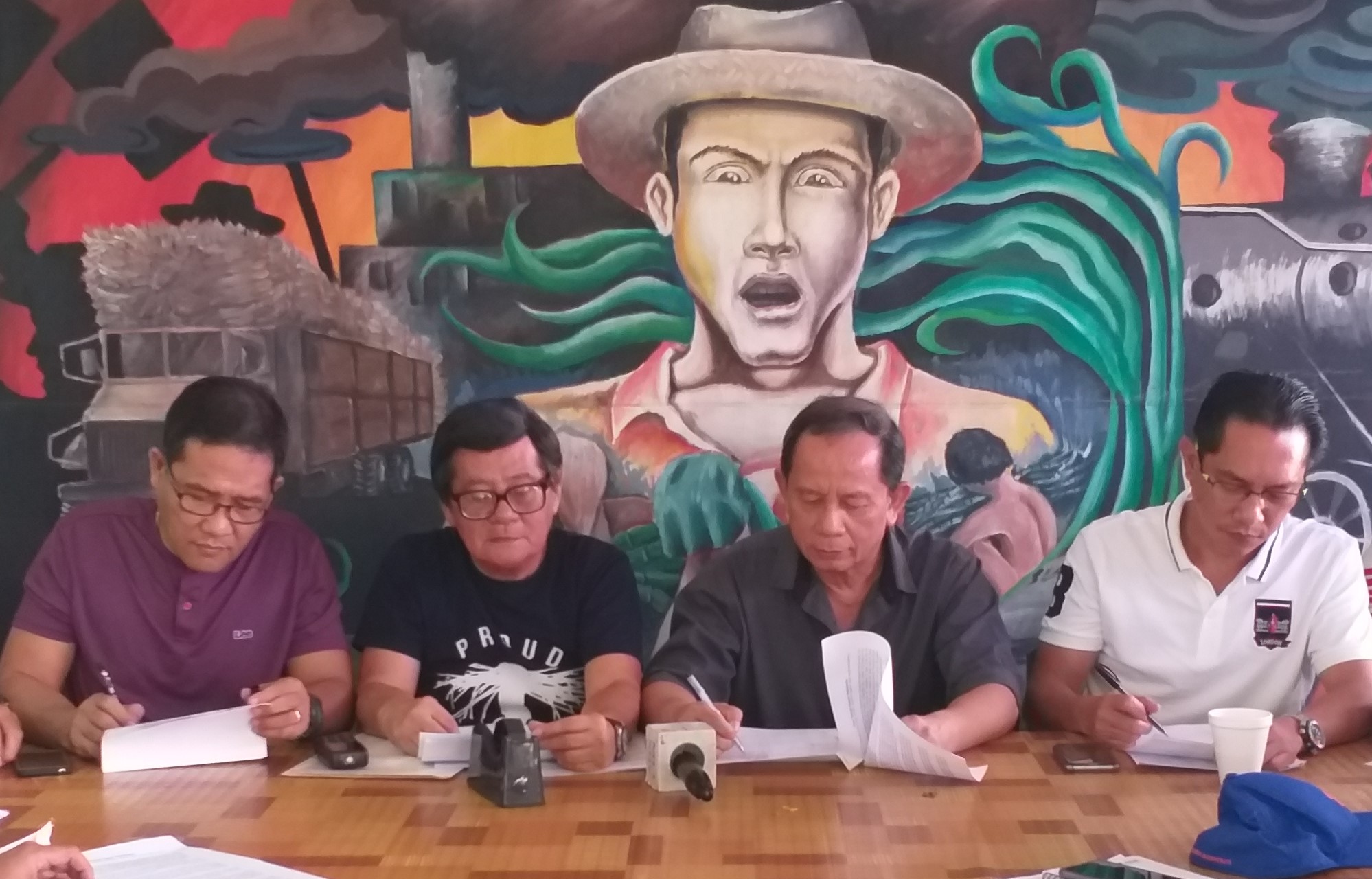
National Congress of Unions in the Sugar Industry of the Philippines national president Roland De la Cruz (seated, right) and officials of allied labor organizations launch the signature campaign strongly opposing the proposed liberalization of sugar imports in Bacolod City on Saturday, Feb. 23, 2019.
Contributed photo
This is the result of the various efforts of the industry sectors after the Sugar Summit spearheaded by the Sugar Regulatory Administration and the Department of Agriculture earlier this month, he added.
De la Cruz and officials of the Philippine Agricultural, Commercial and Industrial Workers Union (Paciwu), Congress of Independent Organizations (CIO), and Fraternal Labor Organizations (FLO) launched the campaign in a gathering held in this city on Saturday.
They were the first signatories to the open letter addressed to President Rodrigo Duterte, which they dubbed as a call and appeal from the workers, citizens, and families who are dependent on the sugar industry.
“We hope the President will get the pulse of the industry before finally deciding on the proposal. There is a big chain of interconnectivity here, if the sugar industry gets killed, everything else will follow,” de la Cruz said.
He added that their action is not just confined in Negros Occidental, the country’s top sugar producer, since the industry also includes other regions in Luzon, Visayas and Mindanao.
De la Cruz said that in Bacolod, they launched the English and Hiligaynon versions of the open letter, and they will soon come up with a Tagalog version.
“We are looking that after three months, we can submit the open letter to the President along with the signatures we have gathered,” he added.
In the open letter, they called on the government and the President “to junk and totally discard the proposal to liberalize the importation of sugar.”
They pointed out that “unrestricted sugar importation” will “cause closures of sugar mills, massive dislocation and retrenchment of workers, and widespread unemployment of workers and farmers.”
“The entry of imported cheap sugar from abroad with regulation and safety nets will destroy the sugar industry, our economy and the future of our children as well as the welfare of all the citizens of this province and of the whole country,” they added.
“We represent the workers and the citizens who are directly and indirectly dependent on the sugar industry, those who are working in the sugar mills, sugar farms and to those families who will be affected by the liberalization of sugar imports,” the groups further said.
Budget Secretary Benjamin Diokno earlier said that while the planned liberalization of sugar imports would negatively affect local producers, this would benefit a greater number of consumers.
He added that the plan to import some 200,000 metric tons of sugar seeks to address the elevated domestic inflation rate last year caused by supply-side factors, such as the lack of supply of rice, meat, and several other agricultural products. (PNA)
 Stories from the Sugarlandia