W. Visayas wage board to decide on ‘kasambahay’ pay hike

BACOLOD CITY — The Regional Tripartite Wages and Productivity Board in Western Visayas (RTWPB-6) is set to deliberate on the proposals to increase the wage of household workers or “kasambahay” after conducting two public hearings.

The second and last public hearing was held in this city on Thursday amid oppositions to the proposal.

Wennie Sancho, labor representative to the RTWPB-6, said a group proposed to place under status quo the current monthly salary rate of domestic workers in the region.

In Iloilo City on Tuesday, some groups also objected to the increase and moved for the same proposal, he said.

Wage Order No. 2, which lapsed last December 8, prescribed a minimum wage rate of PHP3,500 per month for domestic workers in Western Visayas.

The order removed the classification of “kasambahay” since all are now entitled to receive the same wage rate regardless of whether they are working in cities or different classes of municipalities.

Sancho said other proposals include a PHP500 and a PHP1,000 increase per month, wherein the latter was pushed by non-government organization and labor advocate “Voice of the Free”, formerly the “Visayan Forum”.

“The wage board will consolidate the results of the public hearings during the two deliberations scheduled before March 15,” he said.

Sancho added the RTWPB-6 is expected to make a decision by the middle of the month.

In Wage Order No. 1, domestic workers in cities and first-class municipalities were prescribed to receive PHP2,500 per month while those in other towns were entitled to get PHP2,000.

The salary of domestic workers in cities and first-class municipalities increased by PHP1,000 per month, and those in other towns, PHP1,500 as provided in Wage Order No. 2.

Under the new proposal, the increase may range from PHP500 to PHP1,000 per month.

If approved, all household workers in Western Visayas will be entitled to get a monthly wage of up to PHP4,500. (PNA)
Source: http://www.pna.gov.ph/articles/1063313

Negrense groups protest proposed sugar import liberalization

BACOLOD CITY — More groups in Negros Occidental have manifested their protest to the proposed liberalization of sugar imports.

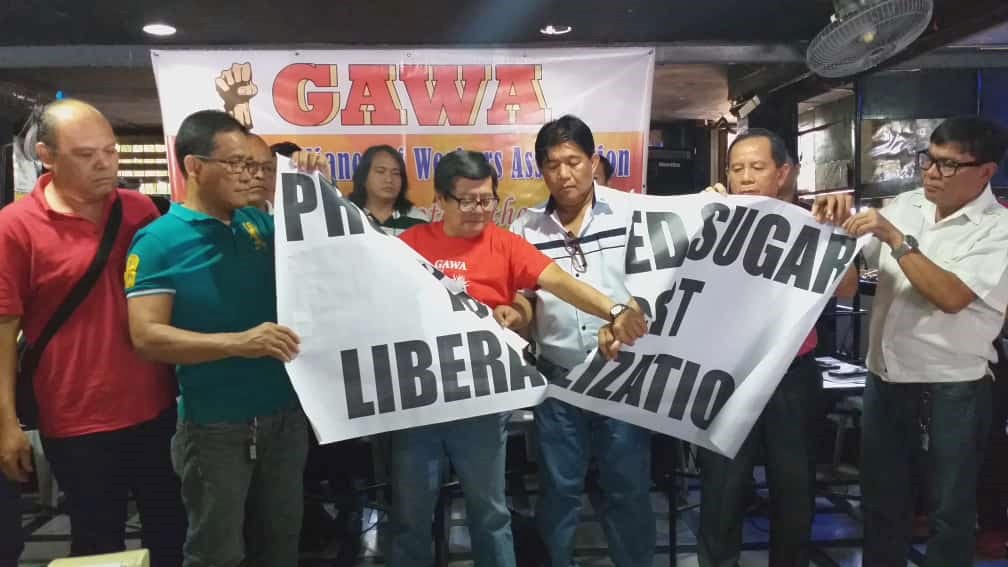
Leaders of the Solidarity of Workers in the Sugar Industry (SWSI) and the Save the Sugar Industry Movement (SSIM) expressed their opposition by tearing a replica of the proposal in a forum held at Gerald’s Restobar here on Thursday.

SSIM convenor Wennie Sancho said the tearing of the replica, which is a wide piece of paper with a text that read “Proposed Sugar Import Liberalization,” emphasizes their crusade against government economic managers’ proposed “deadly” policy.


Save the Sugar Industry Movement convenor Wennie Sancho (3rd from left) leads the symbolic tearing of the sugar import liberalization replica during a forum of labor groups in Bacolod City on Thursday (Feb. 7, 2019).
Photo by Erwin P. Nicavera

“If we wait for this sugar import liberalization to materialize, we would have waited too long. We must confront the worst threat before they emerge,” Sancho added.

“The only path for the survival of the sugar industry is the path to action. Let us protect sugar and save Negros by action,” he added.

The statement of solidarity released by SSIM and SWSI stated that advocates and multi-sectoral cause-oriented leaders from different labor organizations in Negros Occidental condemn in the strongest possible terms the proposed measure as it would obliterate the local sugar industry displacing thousands of sugar workers and their families.

They added that a disaster would come upon like an overwhelming flood, if the sugar industry will collapse as a result of sugar import deregulation.

“It is our right and our moral duty to oppose sugar import liberalization because the anticipated economic damage, if not prevented, would be greater and dangerous,” the groups added.

Meanwhile, the Sugar Farmers Federation-Kilusang Pagbabago — composed of 11 associations in Negros Occidental — said in a statement the country’s economic managers, who are pushing for the sugar imports liberalization, should know their place in policy-making.

“We campaigned and voted for President Rodrigo Duterte to lead us and make decisions for our nation. We did not vote for you, economic managers, so you don’t have the right to make decisions or proposals which will affect us, the 5 million Filipinos who depend on the sugar industry for our livelihood,” the group’s chairman Aaron Sorbito said.

“Our marginal farmers, mostly agrarian reform beneficiaries, need government support to lower cost of production and increase yields, not import liberalization,” he added.

On Wednesday, the Senate passed a resolution urging the Executive Department not to pursue the plan to liberalize the sugar industry to safeguard the economy and welfare of sugar farmers and workers in 28 provinces in the country, including Negros Occidental.

Economic managers of the administration earlier proposed the liberalization of sugar imports due to high prices of local sugar against those in the world market and that the same affects the competitiveness of sugar-containing food products for export.

Budget Secretary Benjamin Diokno earlier said that a 30 percent to 40 percent tariff rate is being eyed on sugar importation. (PNA)

Source: http://www.pna.gov.ph/articles/1061298

Workers’ groups launch manifesto vs. sugar import liberalization

BACOLOD CITY — Three labor groups launched a manifesto expressing their opposition to the liberalization of sugar imports, a proposal that has been met with protests by sugar industry stakeholders in Negros Occidental since last month.

The position paper, titled “The Karga-Tapas Manifesto”, was signed by leaders of the General Alliance of Workers Associations (GAWA), Philippine Agricultural, Commercial and Industrial Workers Union -Trade Union Congress of the Philippines (Paciwu-TUCP), and National Congress and Unions in the Sugar Industry of the Philippines (NACUSIP) in a forum held at the Geocadin Building in this city on Monday.

Karga-Tapas is Hiligaynon for a farm worker whose job is to cut and haul sugarcane.


Wennie Sancho (2nd from left), secretary general of General Alliance of Workers Associations, and Hernane Braza, (2nd from right), national president of Philippine Agricultural, Commercial and Industrial Workers Union-Trade Union of Congress of the Philippines, lead the signing of the “The Karga-Tapas Manifesto” opposing the proposal to liberalize the importation of sugar in Bacolod City on Monday, Feb. 4, 2019.
Photo by Erwin P. Nicavera

“If this plan will materialize, it will obliterate our local industry that would result into severe economic dislocation of thousands of sugar farmers and workers. The economic disaster that would occur would be unparalleled in the history of our province,” the labor groups said in the manifesto.

Negros Occidental, considered the country’s sugar capital, produces close to 60 percent of the Philippines’ sugar output.

GAWA secretary general Wennie Sancho said the position paper is in reaction to the pronouncement of Budget Secretary Benjamin Diokno to “relax” the rules or deregulate the importation of sugar.

Sancho signed the manifesto together with Paciwu-TUCP national president Hernane Braza and NACUSIP national director Jun de la Cruz.

Both Sancho and Braza are also labor sector representatives to the Regional Tripartite Wages and Productivity Board – Western Visayas.

According to the labor groups, the economic managers need to consider the implications of the sugar import liberalization scheme, as it would come “at the cost of the economic well-being of the people.”

Copies of the manifesto will be furnished to Sugar Regulatory Administration chief Hermenegildo Serafica and two members of the Sugar Board, representing the planters and the millers, to be presented during the Sugar Summit in Manila on February 11.

Last week, Diokno said while the planned liberalization of sugar imports would negatively affect local producers, this would benefit a greater number of consumers.

“There are more consumers than sugar producers,” he told the Philippine News Agency (PNA).

The plan to import some 200,000 metric tons of sugar seeks to address the elevated domestic inflation rate, whose upticks last year was caused by supply-side factors, such as the lack of supply of rice, meat, and several agricultural products, Diokno said. (PNA)

Source: http://www.pna.gov.ph/articles/1061018

Employers urged to pay P5 COLA for sugar industry workers

BACOLOD CITY — Employers in the sugar industry enterprises in Western Visayas were urged to pay their workers the PHP5 daily cost of living allowance (COLA) starting January 17.

Labor sector representative Wennie Sancho made the call on Thursday after the effectivity of the allowance was tackled by the Regional Tripartite Wages and Productivity Board (RTWPB)-6 (Western Visayas) in its earlier meeting in Iloilo City.

“They have to faithfully pay it. It’s just a small amount,” he said.


Wennie Sancho, labor sector representative to the Regional Tripartite Wages and Productivity Board-Western Visayas.
File photo by Erwin P. Nicavera

Sancho said the living allowance would help minimum wage earners in Region 6 cope with the rising cost of petroleum products, which also leads to the increase in the prices of basic goods.

“It (PHP5 COLA) is one of the new provisions of the latest wage order,” he added.

Wage Order No. 24, which was approved by the RTWPB-6 in June last year, provides that such allowance will take effect six months after the wage increase became effective in July 16, 2018.

Sancho said the Department of Labor and Employment-6 headed by Regional Director Cyril Ticao is expected to issue an advisory on the effectivity of the PHP5 living allowance.

Wage Order 24, which mandated an increase of PHP13.50 to PHP41.50 in the daily minimum wage in Region 6, provides for the said COLA among workers of sugar industry enterprises in the agricultural, industrial, and commercial sectors.

The current minimum wage in Western Visayas, including the living allowance, is pegged at PHP295 and PHP365 per day.

Another provision includes the effectivity of the wage increase on Boracay Island starting January 27.

The island-resort was closed for six months from April to October last year. As part of the moratorium, the new wage increase will take effect only three months after the re-opening of the island.

Considering that business operations in the entire Aklan were also affected, the wage increase took effect in other areas of the province only last November 2018. (PNA)

Source: http://www.pna.gov.ph/articles/1059245